Email gets a bad rap. Well, actually, it might be largely deserved, but that’s not the fault of email itself. Everyone loves the ding of a good email showing up. A unique part of being a writer is waiting a long time for an email only to have it be a rejection. Writers, then, especially need some nice emails. Long story short, Mitch Nobis wanted more good emails, and because he also likes interviewing writers, Inbox Wisdom: Email Interviews on Creativity was born.
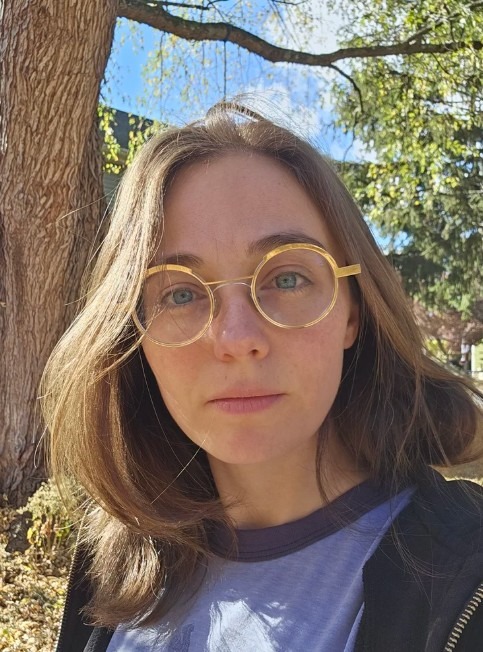
Chiara Di Lello is a queer writer, artist, and educator whose new poetry collection, Childless Millennial, is available from Game Over Books at https://www.gameoverbooks.com/store/p/childless-millennial-chiara-di-lello. Born and raised in New York City, she now resides in the Hudson Valley where she teaches students of many ages in creative and academic settings.
This question comes up in almost every interview or Q & A session I’ve seen recently, so let’s start with it here, too. How are you finding time or energy for creative work amid the United States’ current political and humanitarian crises? I firmly believe that art not only still matters but may matter even more, so how are you engaging in your creative work when reality may be weighing heavy on the mind and body?
Whew. Quite the question. Art and creativity do feel especially vital to me in this long bad series of Nows, but for specific reasons. I write because it fills my tank and keeps me connected to my humanity — which in turn allows me to stay in the fight in various ways within my community. I do also value art as a way to call out perpetrators or mobilize allies and imagine better worlds for all of us. But I think when it comes to stopping genocide, resisting fascism, and protecting each other, we have to acknowledge the limits of what art can do. My dream is for us (writers, artists) to make awesome things while also doing our bit for collective liberation.
That said, the way I find time when I am most overwhelmed is to remind myself that these fights are ongoing. Even the things that feel utterly urgent can wait two or three hours; I can take that time to read and write and think and the work will still be there.
I love that answer. In a sense, we make art because it’s good to make art, and we do it in addition to and alongside daily life regardless of what’s happening across the nation. You mentioned taking time to read (which I’m not doing enough of lately myself), so let’s turn to your new book, Childless Millennial. Tell us a bit about it, and as for reading, what other writers and texts playing a role in inspiring the work that appears in the book? Like, who or what were you reading while in the writing process for your poetry collection?
It is indeed good to make art — to make things in general, even.
So, Childless Millennial is indeed about being childfree, but it turns out to write about that I had a lot to say first about mothers! Early on, before I realized that I was writing a book about not having kids, I produced a cluster of poems that are about my mother and grandmother, and trying to make sense of what has been passed down to me in terms of language, culture, labor, gender, and even things like physical nurturing and touch. When it comes to those themes, I have learned so much from poets like Eugenia Leigh, Han VanderHart, and Erika Meitner — they all do a brilliant job of writing beautiful poems about difficult things, and making visible the deep threads of history that we are entangled with as we go about our daily lives.
There’s another group of poets I turn to for their way of capturing the absurdities of modern life: folks like Emilia Phillips, Natalie Shapero, Alina Pleskova, and Erin Hoover. I borrowed a line from Erin in a poem about one of my niblings, Noah.
I am also very grateful for Leslie Sainz’s work about her Cuban-American heritage and Alina Stefanescu’s about her Romanian roots because they both write about lineage in a way that is political and lyrical AND critical, because we’re inevitably in tension with these expectations of us. I think that requires a productive stubbornness that I admire very much. Also, yes, I did just name all three of my blurbers — but I think that’s exactly what I look for in blurbs anyway: that sense of who the author is in conversation with.
I love that note about blurbs, and that makes SO much sense–of course the blurb authors would and should be ones the poet is in conversation with! Also, your comment about the “threads of history” we’re always twisted up in made me think of the visible and invisible ways the world impacts writers, artists, or anyone in creative efforts. Let’s ride that idea over to your own process. How much of your writing is a conscious effort to sit and write, and how much is that invisible kind of inspiration that likes to strike at weird times when you don’t have a notebook nearby? A more normal way of asking this question might be, how does your normal writing process look?
I’d say my process has seasons. Whenever possible, I try to treat writing like a part-time job, one I clock into for a few hours early in the day when my brain is less crowded with day-to-day minutiae. If I show up and don’t have anything to say, I read — reading itself is a big chunk of my process — and then freewrite for at least seven minutes even if the result is terrible. The biggest difference I notice with this regular practice is that it makes me more likely to have those moments of inspiration at other weird times: they’re more available to me, or I’m more available to them, more porous to the world. A poem that has been one of my most “successful” came to me as I was changing over the laundry in the basement! But there was training, so to speak, to be attuned to that moment.
My other hobbies also remind me, annoyingly, of things I find to be true about writing. Weightlifting reminds me that showing up consistently beats occasionally going all-out, especially knowing how frustrating it is having to on-ramp myself (yet again!) back into a regular practice. Gardening reminds me both that I only have so much control over things, and that I can really only do one thing at a time — my job is to show up and tend what’s there.
Yes, I love that about weightlifting and gardening! A while back, I was lucky enough to get an essay accepted in How to Write a Novel, a book edited by Aaron Burch that collects essays about writing that never mention writing. My chapter was on shooting baskets, so I totally hear you on that answer. We improve at anything through repetition, and I love that you called that “training.” So good. I also love that you put successful in quotation marks in your answer. Let’s talk about that a bit. This is an interview series about creativity, mostly with writers. How do you define success for your work? Or for others’ work? How do we quantify success in creative ventures?
You and Gaby Calvocoressi would have lots to talk about — they host their office hours on basketball courts whenever possible.
Whew, I could walk around with that “success” question for weeks. A question I often ask across art forms is “does it make me (or people) feel more human, or more in touch with my/our own humanity?” I ask this of films, theater, visual art — you name it. It could be earnest af or the darkest most ironic parody, but if it’s getting people in touch with our humanness I will dig it. Does this mean I get very upset and turned off by truly nihilistic work? Yes, but I think I’ve made peace with that. There is so much that’s deeply fucked up about the country and era I live in; I’m not going to force myself to like or uplift work that doesn’t posit or at least believe in something better.
I also believe that creative works “succeed” when they get me to see things as their maker sees them , so I stand there and go, “wow, yes, it really is like that, isn’t it.” That is the encapsulation of so many artists and poets I love.
When I was just a year or two out of college I heard a keynote speech by David Carr, who was a librarian and teacher and sort of museum advisor. He said libraries and museums are places people go to lead less accidental lives. And in the context of his work that was an argument for so many things: public spaces. Civic discourse. Slowing down and thinking and empathizing. Now, a decade and a half later, I am still interested in that. In my teaching and writing, community work and whatever else, I want to do and make work that helps people lead less accidental lives.
Also, if I sell one hundred copies of my chapbook I’ll be over the bleeping moon.
Right? I’m still so surprised when I hear from a reader and it’s someone I don’t already know in real life. That feels like a magic trick to me. Also, I need to add that I read somewhere on Twitter back when it was good that 100 sales is essentially a bestseller for poetry, so you picked the right number! Poetry doesn’t sell much, so I say feel good about getting it published at all and celebrate every little bit of good news you get about it!
And that’s awesome about Calvocoressi holding office hours on the court. Amazing. Speaking of Old Twitter, Gaby is a good example of what many of us lost when Twitter was, let’s say, deconstructed by its new owner. I used to converse about poetry and basketball with people like Calvocoressi, Hanif Abdurraqib, Aimee Nezhukumatathil, and other huge names in poetry. I really miss that, largely because it’s kind of impossible to recreate that in daily, in-person life. This brings up the question of community. Are you someone who is more creative in isolation or with a community? Do you have a writing group, or do you mostly fly solo? I’m always amazed by the wide range of preferences we creative types have on this.
I did like that about long-ago Twitter, the feeling that you could yell someone’s name in an infinitely crowded room and they’d hear you, and maybe even respond. (It definitely stopped feeling like that under the algorithm, let alone under technofascist takeover.)
As far as writing community goes, in the past I experienced a lot of isolation as a writer, so I feel very lucky to have a writing group now. We’re all located in the Hudson Valley and write in a variety of genres, so the feedback I get on my work is a nice mix from both poetry nerds (complimentary!) and, say, screenwriters. I’m also grateful for the handful of folks who I may only know from the internet or one short workshop, but we’ve become Poetry Friends and swap drafts. Parsing someone else’s work and reflecting it back to them is great writing practice! I like to hope that it helps me do the same for my own work.
Overall, I would say most of my actual writing gets done solo. That said, no one writes a book alone. We are all in conversation with someone or something (like we were talking about earlier with blurbers). So I putter along and produce my drafts, most of which no one sees. But I do feel the need, eventually, to hold my work out to someone I trust and say “What is this doing well / not well?” and get their perspective. That was a vital step in getting my chapbook to evolve from a mess to a viable manuscript. That’s also what kickstarted my latest project: I was at my first ever residency at the end of 2024 and felt totally at sea until we had a day of sharing our works in progress. Seeing another poet’s (very different) work and having someone to talk to about this big amorphous topic I was trying to write my way into really unlocked things for me.
Ha, good point because between my two kids, we’ll be at one baseball field or another for 9 of the next 10 days. I like your answers about how seeing someone else’s work that’s in a totally different vein can help unlock something for your own writing. I think sometimes I get as many ideas while reading fiction and nonfiction as I do from reading poetry, for example. Anyway, yeah we should probably wrap this up. This has been a pleasure! For your last question, you already told us a little about Childless Millennial, so what do you think you might focus on next? Are you in the middle of a project, writing randomly, or something altogether different? How does your creative works look as a finished product versus one in-progress?
My next project is underway, but definitely still finding its shape. I’m writing about my Italian-American family, with a particular focus on the “whitening” of southern European immigrants. There’s lots to unpack in my recent family history around mental health, queerness, and creativity, but I want to write into all that with whiteness as the frame, because the process of assimilating and accessing power and privilege has so many reverberations and consequences within and beyond the personal. The poems I have so far are much more hybrid than Childless Millennial. I’ve been making collage and text-based poems using family photos and artifacts, and there may also end up being more prose or essayistic sections. Even as I describe this “project,” I’m wary of starting out with too much expectation around what I’m producing. There’s always a little bit of Roethke: “I learn by going where I have to go.” (Link: https://poets.org/poem/waking)
Oh, I love Roethke, and not just because I’m a fellow Michigander. That’s a great way to end this interview. Your next project sounds amazing, and thanks again for doing this interview, Chiara!
Inbox Wisdom is an interview series conducted by Farmington writer Mitchell Nobis. He is the author of The Size of the Horizon, or, I Explained Everything to the Trees (Match Factory Editions, 2025). He also hosted the Wednesday Night Sessions reading series for KickstART Farmington, facilitates the Teachers as Poets group for the National Writing Project, and co-founded the Not at AWP (NAWP) reading series. For more, see mitchnobis.com.

